
If you don't understand AI, you'll be left behind tomorrow

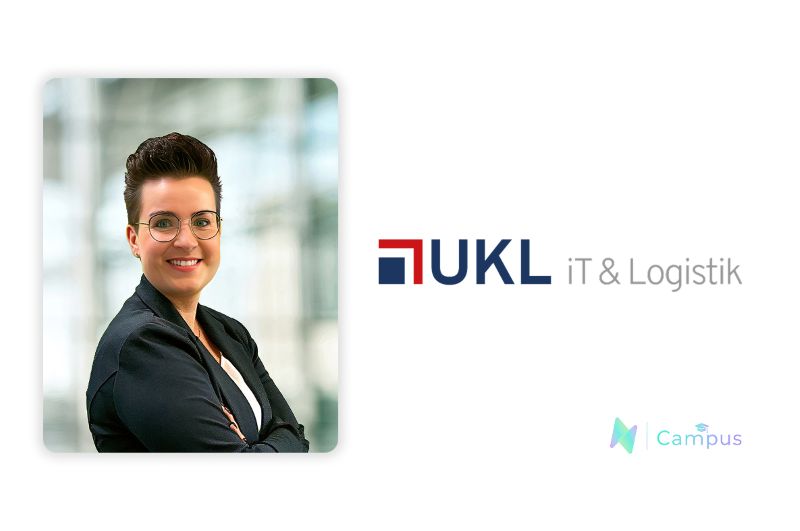
AI training with UKL: An interview with Carolin Katona, Managing Director of UKL iT & Logistik GmbH

Hamburg, 05. Juni 2026 – UKL iT & Logistik GmbH is taking a consistent approach to artificial intelligence—not as a trend, but as a strategic necessity. Carolin Katona, Managing Director of UKL, took part in our AI training together with her team. In the interview, she talks about anxieties around AI, using it responsibly, and why waiting is not an option.

Enjoy the interview:

Please introduce yourself briefly—who are you, and what does your company stand for in the rail industry?
Of course. My name is Carolin Katona, and I am the Managing Director of UKL iT & Logistik GmbH. We develop digital solutions for rail transport and support our customers with software, logistics services, and extensive IT and rail expertise. Our aim is to strengthen rail transport and make it more sustainable by building bridges between a wide range of stakeholders.
What personally prompted you to explore artificial intelligence? Was there a specific moment or situation that proved decisive?
As a modern company looking to offer smart solutions for the rail industry, both today and in the future, we naturally consider which technologies will shape the world of work tomorrow. The widespread breakthrough of ChatGPT made it clear that AI is not a short-term trend, but will sooner or later change the way we work. It is our responsibility to understand what opportunities this presents for UKL, our employees, and ultimately our customers.
What specific challenge or question led you to take the training? What did you want to clarify for yourself or your company?
It was important to us to establish a shared level of knowledge among all UKL employees while also addressing opportunities & risks. By now, almost everyone has probably tried “something involving AI” in their personal life. But how and where does it make sense in the workplace? What possibilities are there, and where are the limits? We wanted the training to give us a solid foundation for answering these questions.
What surprised you most or got you thinking during the training?
The subject as a whole inspires both curiosity and uncertainty. On the one hand, it is exciting to see all that is already possible today and how we can use it to make our working lives easier. On the other hand, the technology is evolving at an incredible pace, which raises questions and concerns for many people. However, the training made it clear that people continue to play a crucial role in the age of AI. That is important—and rightly so.
Was there a topic or practical example that you could immediately apply to your own situation? What was it?
Yes, for example, reviewing the privacy and security settings in your own ChatGPT account. There were also fascinating insights into prompt engineering and various AI tools I had not known about before. This made the subject of AI more tangible and practical overall.
What has changed since the training—in your thinking, your planning, or your day-to-day work?
I think the training has mainly helped reduce apprehension and increase openness to AI applications. At the same time, it has also heightened awareness of the risks, data protection, and the responsible use of AI.
If you could offer one piece of advice to an industry executive who is still undecided, what would it be?
Anyone who does not at least try AI today and start to understand it will struggle to use its potential for their own company tomorrow.
What is the next concrete step you or your company will take toward using AI?
We already use AI in software development and marketing. Now, however, we will take a closer look at further possibilities, including for our internal processes and administrative tasks. Our main goal is to relieve employees of routine tasks and give them more time for work that calls for experience, expertise, and personal judgment.
  Thank you, Carolin and team!